

Link building has been the backbone of SEO for decades. Get reputable sites to link to yours, build domain authority, rank higher in search results — it’s a well-worn playbook. Entire agencies were built on it. Countless hours have been spent on outreach, guest posts, digital PR, and partnerships, all in service of that backlink count.
So where does link building fit in a world increasingly shaped by generative AI? Is it still relevant? Does the old playbook transfer? The answer is yes and no — and understanding the nuance matters if you’re trying to allocate your link building efforts intelligently.
What Hasn’t Changed
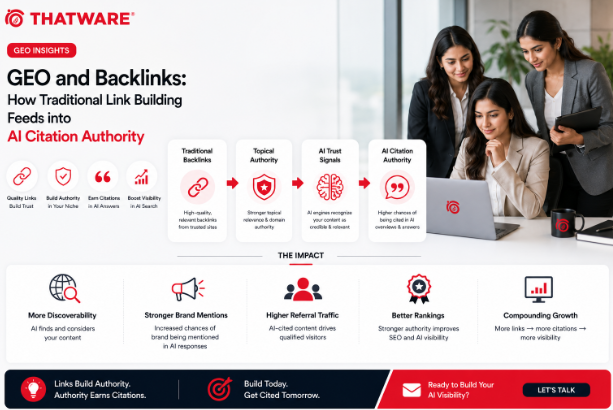
The fundamental principle behind link building still holds: when authoritative sources reference your content, your brand’s credibility increases in the eyes of evaluating systems — whether those systems are Google’s traditional algorithm or the retrieval layers of modern AI tools.
In fact, in some ways the why behind link building has become cleaner. Traditional SEO incentivized some link acquisition practices that were more about gaming an algorithm than establishing genuine credibility — private blog networks, link exchanges, paid placements disguised as editorial. These tactics worked (to varying degrees) because the old algorithm had specific exploitable patterns.
AI systems are less easily gamed. They’re drawing on a broader web of signals and making more holistic judgments about whether a brand is genuinely authoritative or just appears to be. Links from genuinely reputable, editorially maintained sources carry meaningful weight. Links from low-quality sources, manufactured content farms, or obviously transactional placements? Much less so — and potentially counterproductive if they create an inconsistent or incoherent entity signal.
The quality bar has effectively risen. That’s a good thing for brands willing to invest in legitimate authority building.
How Backlinks Feed AI Citation Authority
There are a few distinct ways that link acquisition work feeds into GEO performance.
Reference signals. When authoritative sites link to your content — especially in contextual, editorial placements — they’re telling AI retrieval systems that your content was considered worth referencing by a trusted source. Over time, content that’s consistently linked from credible sources becomes more likely to be drawn into AI-generated answers.
Entity association. Links from categorically relevant sources reinforce the topical entity associations that AI systems build around your brand. A link from a respected cybersecurity publication to your security-focused content strengthens the AI’s association between your brand and that domain. Links from unrelated sources don’t do this — and a link profile full of irrelevant placements can actually create noise around your entity signals.
Discoverability and indexing. AI systems that rely on web retrieval can only use content they’ve indexed. High-quality external links remain one of the primary signals that lead to deeper and more consistent indexing of your content.
The Shift Toward Citation-Worthy Content
Here’s where GEO changes the link building conversation in a meaningful way. Traditional link building often focused on acquiring links to existing pages — finding opportunities to point external sites toward content that was already live. GEO-oriented link building starts one step earlier, with the question: what should we create that’s inherently worth citing?
AI-powered search optimization services that take a GEO-first approach to link building will often begin with content strategy — identifying the data, research, frameworks, or reference materials that would naturally attract citations from authoritative sources in your category. Then the outreach and amplification work follows, rather than leading.
This is a more sustainable model. Content that earns links because it contains something genuinely valuable — original research, a useful tool, a comprehensive explainer, a novel framework — continues to accumulate citations over time. Content that attracted links through manual outreach and relationship leverage often plateaus.
Digital PR as GEO Infrastructure
Digital PR — the practice of securing editorial coverage and citations in media and authoritative publications — has always had SEO value. For GEO, it’s even more directly relevant.
Journalists cite sources. When your brand is cited as an expert source in a trade publication, a business outlet, or a niche industry blog, that attribution creates exactly the kind of external reference signal that AI systems use to establish and reinforce authority. A brand cited in twenty relevant editorial placements over the course of a year builds a very different AI entity profile than one that only exists on its own website.
This is worth thinking about when allocating communications and marketing budget. PR spend that drives editorial coverage isn’t just about brand awareness anymore — it’s building the citation infrastructure that feeds AI visibility. That makes the ROI case for digital PR even stronger than it was a few years ago.
Anchor Text and Contextual Relevance
For traditional SEO, anchor text in backlinks carried a significant ranking signal — links with keyword-rich anchor text helped pages rank for specific terms. For GEO purposes, the contextual relevance of the content surrounding your link matters more than the specific anchor text used.
An editorial paragraph that says “according to [Brand], the key challenge in enterprise data migration is…” and links to your content is more valuable for GEO purposes than a bare URL mention, regardless of what the anchor text says. The surrounding context reinforces the association between your brand and the topic being discussed.
This is another reason to prioritize editorial placements over transactional link acquisition. Context-rich references do more work.
What This Means for Your Link Building Strategy
If you’re running a traditional link building program and trying to make it GEO-compatible, the adjustments aren’t radical. The core shift is in evaluation criteria.
Before, you might have evaluated link opportunities primarily by domain authority score and follow/nofollow status. For GEO purposes, the more important questions are: Is this source genuinely authoritative and credible in my category? Will the link placement be contextually relevant and editorial in nature? Is this the kind of source that gets referenced in AI-generated answers about my industry?
If the answer to those questions is yes, the link is likely to contribute to your GEO authority. If the source is high domain authority but completely unrelated to your category, its GEO contribution is minimal. That’s a meaningful shift in how link quality gets evaluated.
The Honest Assessment
The best GEO agency for link and citation authority building will tell you that the tactics haven’t changed as much as the reasoning has. Guest posts on relevant industry sites are still valuable — but because they build contextual entity signals and drive editorial citations, not because of the DA score. Journalist outreach and media relations are still valuable — but now they’re explicitly AI citation infrastructure, not just brand PR.
What’s changed is the clarity of the why. Link building has always worked best when it reflected genuine authority. GEO just makes that principle non-negotiable.
The links that will matter most in an AI-driven search world are the ones you’d be proud of in a traditional sense — earned, editorial, and genuinely authoritative. The algorithm got better at telling the difference. That’s good news if you’ve been doing the right things.